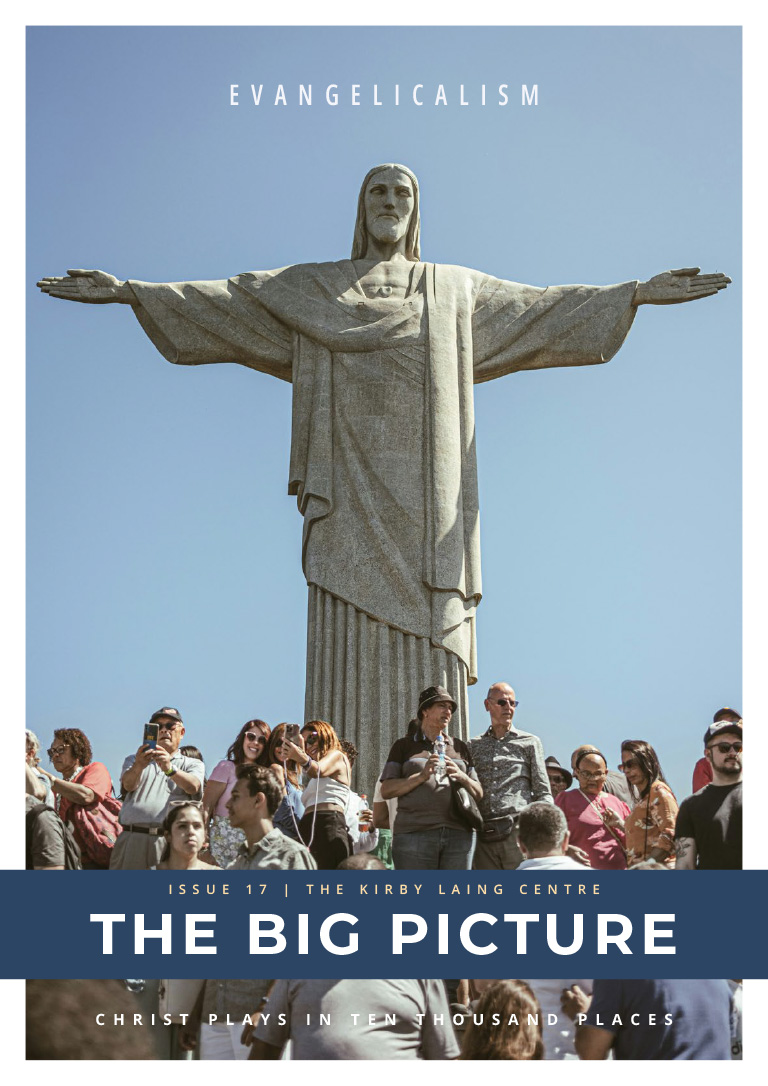
From the Director: The Marks of Evangelicalism
Craig G. Bartholomew
Craig argues that evangelicalism is best understood through four interconnected marks: Christ-centred, biblical, personal, and missional. While acknowledging contemporary crises, especially the politicisation of evangelical identity, he contends that the tradition possesses deep theological resources worth recovering.
Strange in the Right Way: Evangelicalism’s Geopolitical Witness
James Spencer
James Spencer argues that evangelicals, especially in America, are at risk of confusing their national identity with their Christian identity. Yet the church’s distinctive contribution comes not from baptising political systems but from bearing faithful witness to Christ. Evangelicals shouldn’t settle for the Christianising of nations but must take up their prophetic role in society and the live into the distinctiveness of our calling.
Chris’s Column: To Theophilus, with Love
Chris Wright
We are pleased to have been given permission to publish a version of Chris Wright’s foreword to a forthcoming book called Reaching Every Nation by Philip Ryken and Hwa Yung. Chris writes a letter to Luke’s original dedicatee, Theophilus, reflecting on the continuing significance of Luke-Acts for the mission of the church, highlighting the theme of the kingdom of God and the role of ordinary believers in God’s redemptive purposes for the world.
That ’90s Mixtape: What Might Have Been for American Evangelicalism
Cody M. Chambers
“For the sake of this exercise I’ll pull three books down off my bookshelf to see if evangelical ideas from the ‘90s offer us something different when it comes to being a faithful Christian in the world.”
Cody Chambers reflects on other roads that evangelicalism could have followed given the theological direction offered by key authors in the ‘90s.
Healthy Evangelicalism: Reflections from a Career in UK Education
Trevor Cooling
Drawing on decades in education, Trevor Cooling considers the difference between healthy and unhealthy forms of evangelicalism. He reflects on the role that missiology and biblical hermeneutics played in helping him to move beyond the defensiveness of his early faith and toward a more confident, constructive engagement with education.
The Great Butler and What’s Missing from Bebbington’s Evangelicalism
Jordan Pickering
Using Kazuo Ishiguro’s The Remains of the Day as a point of departure, Jordan examines evangelicalism’s present challenges and asks whether David Bebbington’s famous fourfold definition is enough. He proposes a fifth hallmark: ambassadorship. Christians are called not merely to believe rightly but also to embody the character of God’s kingdom in their public conduct — to live out a Christian ethos and to represent their heavenly citizenship with distinction.
Evangelicalism: The Need to Return to Christ
Karen Harding
Harding offers a candid and pastoral critique of contemporary church life. Through her experiences in church and mission, she questions whether many churches have become overly institutional, self-protective or disconnected from genuine discipleship.
Religious Illiteracy and Organisational Failure: From 9/11 to Evangelicalism
Rosemary Vogt
Western institutions have long misread religiously motivated behaviour from 9/11 to the MAGA-evangelical alignment because they lack the organisational frameworks to take religion seriously as a causal force. This essay asks what healthy evangelicalism looks like and what it could contribute geopolitically.
Political Preaching in Evangelical Pulpits?
Michael Wagenman
Should pastors address political issues from the pulpit? Michael Wagenman discusses the dangers both of ignoring politics in church and of bringing partisan loyalties to the podium. Drawing on sociology, theology and recent research into church decline, the article offers a careful exploration of how churches might engage contemporary culture while remaining faithful to their distinctive calling.
ArtWay: A Return to Soul: Review of Aaron Rosen’s Spiritual Traces
Jonathan Evens
Jonathan Evens reviews Aaron Rosen’s exploration of spirituality in contemporary art, especially in conversation with artists working at the intersection of creativity and faith. The review offers a thoughtful introduction to current conversations in art and religion while suggesting why beauty, contemplation and artistic practice remain important sources of meaning in a fragmented age.
ArtWay: Charles Wheeler, Slumber
Otto Bam
Otto Bam guiding readers through the evocative imagery of Charles Wheeler’s sculpture Slumber — a slab of stone featuring on one side sleeping parents with a child and on the other a lion resting beside a lamb. Moving between art criticism, theology and cultural reflection, Otto highlights the tensions at play in this piece that point us toward deeper truths.
The Scandal of Evangelical Research: A Monastic Proposal
Craig G. Bartholomew
Craig suggests that evangelicalism is not suffering from a shortage of good scholarship but rather a growing scarcity of research vocations and other outlets for good academic pursuits. Research matters, but it is endangered if there are too few environments to support it. Craig proposes a bold solution drawn in part from Christian monastic traditions of the past.
Ordinary Evangelicals
Justin McLendon
Justin McLendon challenges the assumption that the evangelical intellectual life should primarily be measured by what happens in formal academic spaces. The evangelical mind is not just a matter of scholarship but also the daily formative habits of Christian people. The essay offers a refreshing appreciation of everyday discipleship and suggests that the future health of evangelical thought may depend less on public prominence than on faithful formation.
Vulnerability in Early Christian Formation
Genevieve Wedgbury
Genevieve Wedgbury reflects on aspects of evangelical discipleship that can unintentionally encourage unhealthy forms of vulnerability, especially among young believers. Drawing on personal experience, she argues for the importance of a robust doctrine of creation, greater self-awareness and contemplative spiritual practices. It is a sensitive and personal exploration of spiritual maturity and pastoral care.
The Church Has No Walls
Kevin O’Donnell
Kevin O’Donnell recalls a striking dream of a wall-less church to reflect on Christian unity across traditions. Tracing his own journey through evangelical, charismatic, Anglican and Catholic communities, he advocates a form of “receptive ecumenism” that seeks not merely dialogue but mutual learning.
The Esteem in Which Evangelicals Should Hold Learning
Dennis W. Jowers
“This piece consists in an explanation of why evangelicals should consider learning both a well-nigh indescribably important obligation and a privilege of incomparable worth.”
Dennis Jowers encourages us to treasure the Christian responsibility to form our minds, seeing it as part of our creational calling and contemplation of God.
Sir Kirby Laing (1916-2009)
Ian Randall
Ian Randall has been working on a KLC project to write a biography of our namesake, and the manuscript is now complete. Here he offers a brief portrait of Sir Kirby as businessman and philanthropist, but more than this, as a man whose evangelical faith shaped his commitments to scholarship, education, industry and leadership.
Book Club: The Road – Cannibalism and Community
Jordan Pickering
Our regular book-club column considers Cormac McCarthy’s bleak post-apocalyptic novel The Road. It is easy to get lost in the unrelenting horror, deprivation and violence of McCarthy’s book, but beneath its surface presentation, it is a profound meditation on what it means to be human, confronting us with searching questions about our responses to a broken world.