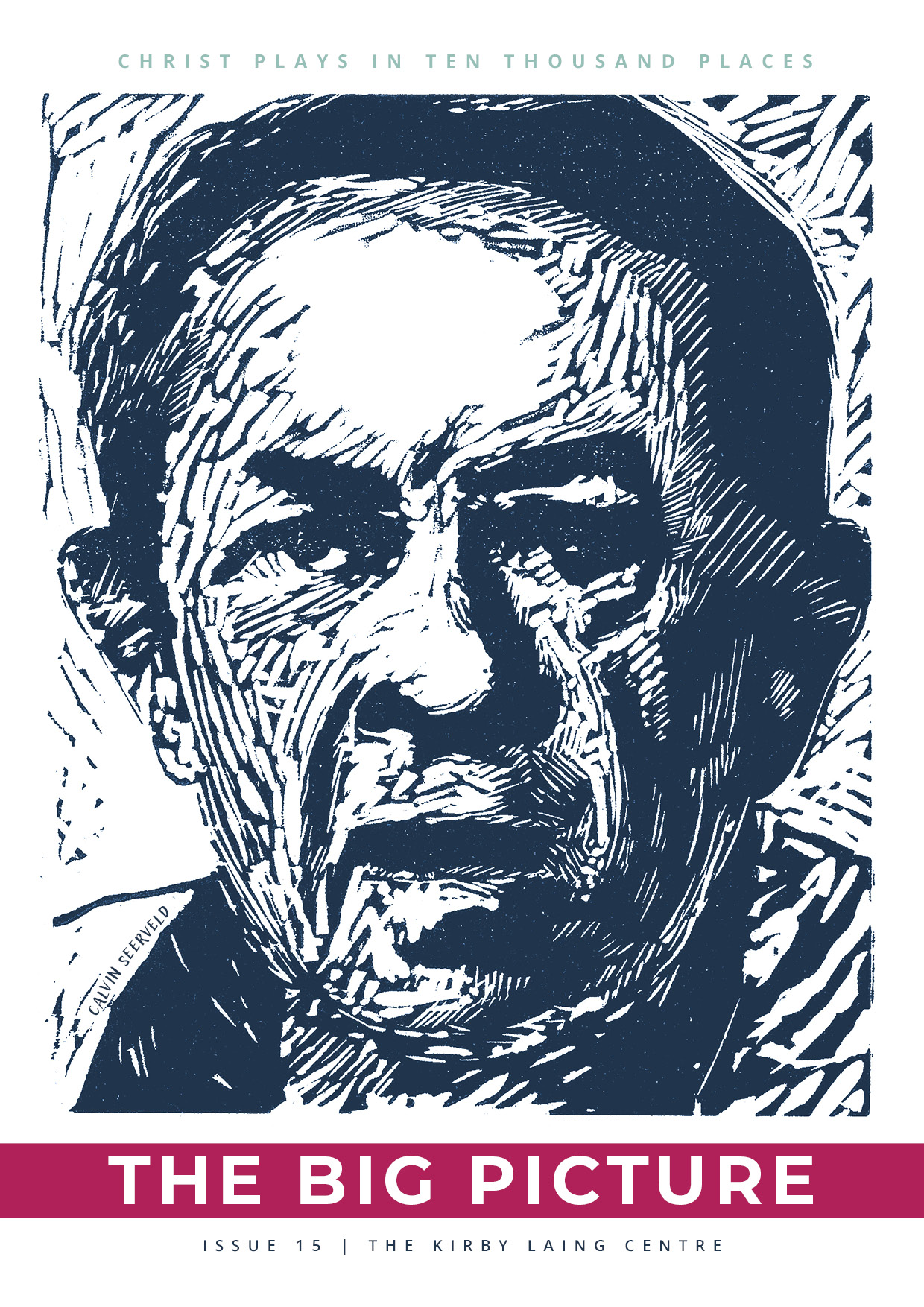
From the Director: A Knight of Faith – The Gift of Calvin Seerveld
Craig G. Bartholomew
Craig Bartholomew reflects on Seerveld’s integrity and his contribution to art and faith, including his influence on the writing of Christians and the Arts in South Africa: A Manifesto, which Craig spearheaded in the early 90s. He highlights Seerveld’s important contributions to the philosophy of aesthetics, his academic rigor and his pastoral generosity.
Aesthetic Obedience: Gert Swart, Calvin Seerveld and the Peace Tree (1991)
KLC Arts Fellowship
This essay explores Seerveld’s intriguing concept of “aesthetic obedience” as he saw it modelled in Gert Swart’s Peace Tree, a collaborative sculpture from the early days of South Africa’s emergence from apartheid. It caught Seerveld’s attention for its use of art as a transformative medium of justice and grace.
Advent at Home
Julie Canlis, Lauren Mulford, Michael Wagenman
Members of our community share practices for reclaiming Advent’s depth, including liturgical rhythms, fasting and storytelling.
Let in the Light
Laurel Weeks
Laurel Weeks shares her poem celebrating everyday beauty as a reprieve from fear and darkness.
Calvin Seerveld on Engaging with Culture
Alastair Reid
Alastair Reid takes us through Seerveld’s guidelines for Christian cultural critique, which help us to avoid superficial judgments and moralistic labeling, and encourage us to engage well with art as a serious pastoral calling.
A Tribute to Calvin Seerveld
Peter S. Smith
Renowned printmaker Peter Smith recalls decades of friendship with Seerveld, sharing memories of conferences, letters and collaborative projects. He reflects on Seerveld’s influence on Christian art movements and honors his humility, wisdom and encouragement. Peter contributed the woodcut of Seerveld for our cover.
Bookclub: What Are You Worth? Dickens’s “A Christmas Carol”
Jordan Pickering
Pickering revisits Dickens’s classic, which is unfairly reimagined in most modern remakes as a story about learning to have Christmas spirit. The original story is much more a critique of narrow, utilitarian (economic!) measurements of human worth, and the need to recapture our sense of the true Spirit who is behind Christmas, the one who calls us to love mercy and to serve the common good all year round.
Seerveld’s Neighbourly Aesthetics
Adrienne Chaplin
Adrienne Chaplin surveys Seerveld’s Reformational aesthetics, emphasizing “allusivity”—imaginative nuance and play—as art’s defining trait. She argues art is societal infrastructure, vital for cultural health and justice. Seerveld’s vision challenges artists and theologians alike to integrate creativity with communal flourishing and prophetic hope.
Calvin Seerveld: the Man
Nigel Goodwin
Veteran of the stage Nigel Goodwin offers a tribute to Seerveld as a personal friend. He recalls Seerveld’s humility and his passion for the arts and for people.
Music for Saints and Sojourners
Sara Osborne
Christian musician Rich Mullins left behind an enduring legacy, underlined recently in the release of Andrew Peterson’s tribute album. Mullins’s lyrics embody the prophetic dimension of art, which challenges us to hold hope and suffering in tension, and orients believers toward Christ’s kingdom—an orientation that can offer powerful witness in our culturally dislocated age.
Artisanal Music with a Prophetic Twist
Mary Vanhoozer
Vanhoozer reflects on crafting “artisanal music”—melodies for everyday use. These melodies are rooted in folk traditions and offer hope, beauty and prophetic glimpses of the new creation.
A Man Seriously at Play
Roger Henderson
Henderson portrays Seerveld as a “seriously playful” scholar whose poetic translations and aesthetic philosophy foreground creativity, improvisation and openness. He links Seerveld’s emphasis on play to his concept of allusivity, framing the aesthetic as a fundamental mode of existence.
Our Place, Our Land: Community Farms as Shared Home
Matthew N. Williams
Williams reflects on Jubilee Farm as a communal space reconnecting people to land, food and creation care. He critiques the alienation and destructiveness of industrial agriculture and our increasing urbanisation, advocating for Christians to recover a sense of place and knowledge of the soil as a core part of our creation mandate.
Interrogating Community Farming: A Dialogue
Matthew N. Williams
Jordan Pickering offers some challenges to the ideas raised in Matthew Williams’s article “Our Place, Our Land,” discussing the viability and theological foundations of community farming. Do we really need to be connected to land? Is farming really an enduring part of the creation mandate, even for us city dwellers? And could this model even work practically? Matthew offers his thoughts.
The Role of Tariffs in International Trade: Christian Perspectives on Trumpian Policy and the Ethics of Reciprocal Tariffs
Andrew Henley
Assisted by several participants in the annual conference of the Association for Christian Economics, Andrew Henley discusses the good and bad of the recent U.S. tariff policies, especially as they relate to fairness and reciprocity. The article calls for biblically informed trade ethics prioritising stewardship, equity and concern for vulnerable nations.
Discipleship Means Migration
- David Stark
David stark argues that Scripture regularly presents us with migration as a motif that is central to our discipleship. He argues that following Christ entails physical and spiritual movement, resisting Babel-like immobility and embracing pilgrimage toward God’s coming city.
ArtWay: Defenseless Churches, Priceless Value
Willem Jan de Hek
Our ArtWay contribution reflects on the spiritual and cultural significance of church architecture, drawing on Makoto Fujimura’s themes of mercy, beauty and anticipation. Willem urges creative restoration of vulnerable sacred spaces as public witnesses of hope and care, pointing also toward creation’s ultimate renewal.
From the Mill
Craig G. Bartholomew
Craig reflects on the contribution of our base at the Chesterton Mill in Cambridge and the need in the new year to move to a new home.