



baseball
car
teddy
dice
acorn

Join the KLC 100

Opinion: The Wheel Turns: Davos, Carney, and Religious Literacy

KLC welcomes civil discussion and disagreement about contemporary issues. Thus, the views expressed in our opinion pieces are not official KLC positions but those of the author.

By Craig G. Bartholomew

My title alludes to Robert Jordan’s extraordinary series of novels. I do not buy into the worldview they embody but “the wheel turns” encapsulates my sense of the meetings that recently concluded in Davos. I recommend you listen to the main speeches if you haven’t already done so. What impressed me was the calm, robust, and clear speeches from the Europeans, making it clear that even as they have tried to appease Trump over the last year, they are not blind to what is going on and are planning accordingly. Ursula von der Leyen spoke compellingly of the need for European independence.

Canadian prime minister Mark Carney spoke of a “rupture” in geo-political relations, and whether this is right or not, it should make us stop and reflect. These are momentous times and we need to think hard about them. As we have seen since Carney was elected, he has been proactive rather than reactive and on all accounts his address was the highpoint of Davos.
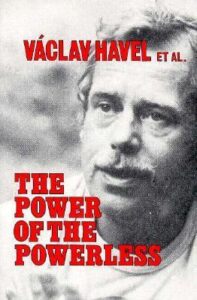
haval power of the powerlessInter alia Carney drew to great effect on the Czech dissident and later president Vaclav Haval’s The Power of the Powerless. This is an important and influential document and readily available here.

Carney referenced Havel’s illustration of the greengrocer who puts a sign in his shop window, “Workers of the World, Unite!” This, as Havel explains, is part of the greengrocer living the lie. Havel goes on to explore what happens if he takes the sign out of his window and starts to live in the truth. “Is it not true”, asks Havel, “that the far-reaching adaptability to living a lie and the effortless spread of social auto-totality have some connection with the general unwillingness of consumption-oriented people to sacrifice some material certainties for the sake of their own spiritual and moral integrity? … And do we not in fact stand … as a kind of warning to the West, revealing to [it] its own latent tendencies?” Havel writes: “If the main pillar of the system is living a lie, then it is not surprising that the fundamental threat to it is living the truth. This is why it must be suppressed more severely than anything else.”

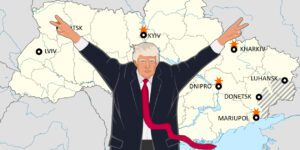
Carney’s reaching for Havel was poignant in our context, because, while The Power of the Powerless was written in relation to communist oppression, here it is being leveraged in relation to the rise of authoritarianism in the USA. If you think this is being overly dramatic, bear in mind that a source of great relief to leaders at Davos was that Trump – as far as we can tell – does not intend to invade and take Greenland by force, which would involve one NATO ally invading another. We were also subjected to Jarod Kushner’s plans for Gaza, but without any sign of consultation with the inhabitants of Gaza, the Palestinians, or their representatives. bne IntelliNews reports that,
Originally meant to oversee the reconstruction of Gaza – without any input from Palestinians -, Donald Trump’s self-proclaimed “Board of Peace” seems to be expanding far past its intended purpose … Donald Trump, who will chair the body indefinitely, suggested on Tuesday it could “replace the UN”, a statement that added to the concerns of some Western leaders.

With permanent seats up for sale for $1bn and a “founding Executive Board” including Trump’s son-in-law Jared Kushner, Secretary of State Marco Rubio, special envoy Steve Witkoff and former British prime minister Tony Blair, the “Board of Peace”‘s stated new aim is to tackle conflicts all over the world – its charter draft, which was sent to countries along with their invitation to join, does in fact not mention Gaza at all.

But while Donald Trump is so far facing reticence from Western leaders, many countries have already accepted a seat at the table. According to CNN, oil-rich Gulf states Bahrain, Qatar, Saudi Arabia and the United Arab Emirates have already accepted the US President’s invitation, as well as several Asian countries such as Indonesia, Kazakhstan and Pakistan. In Europe, two countries have so far officially accepted the invitation: Hungary and Belarus. In Latin America, Donald Trump can count on the support of his far-right ally Javier Milei in Argentina. While the US President claimed earlier this week that Russia’s President Putin had accepted to join the “Board of Peace”, the latter clarified on Wednesday that his Foreign Ministry would “review the documents”.

It is hard not to feel that “the wheel turns”, and not for the better. 

What was conspicuously absent from all that I watched from Davos was any consideration of religion. The Christian tradition underlies Haval’s living in the lie and living in the truth but no one seemed to notice or draw attention to it. One would have thought that after 9/11 the West would have learnt its lesson, namely that for better and for worse you ignore religion at your peril. I saw no sign of this at Davos. How, you might ask, would attention to religion have featured at Davos? A good question! Here are some ideas.

Imagine if Patriarch Krill, the leader of the Russian Orthodox Church, had been invited to attend and to explain how exactly Putin’s brutal invasion of Ukraine is a holy war. Imagine if other representatives of the Orthodox tradition had been able to respond. According to Pew, three months in to his second administration, 72% of white Evangelicals in the US approved of the job Trump was doing. Why not have a MAGA pastor present to explain just how Trump reflects the Christian tradition. And, of course, have a representative of the many, many Evangelicals in the US and elsewhere who do not support Trump in his authoritarian direction. And how about having Muslim representation in relation to Gaza and the Middle East, a Jewish representative, etc.

In her On Looking into the Abyss, historian Gertrude Himmelfarb notes that moderns, for all their weaknesses, are aware that very dangerous monsters lurk in the abyss of history. Postmoderns, by contrast, play around the abyss, relatively oblivious to the dangers. Postmodernism is generally associated with the left, but Trump, with his casual approach to truth, embodies much of its spirit. In this context, rejecting the lie and living in the truth becomes of utmost importance. Here in Europe we have some idea of what those monsters look like when they are released. Alongside Carney and many others, we need to be proactive in living the truth, not least politically and geopolitically, so that the monsters are restrained and justice, peace, and love nurtured.