KLC welcomes civil discussion and disagreement about contemporary issues. Thus, the views expressed in our opinion pieces are not official KLC positions but those of the author.
By Craig G. Bartholomew
“America is strong and respected again – and because of that, we are making peace all over the world.”
You might want to begin by guessing where this statement comes from. Remarkably it comes from Trump’s letter to his fellow Americans that prefaces the National Security Strategy of the United States of America, November 2025. You can read it here: 2025-National-Security-Strategy.pdf. The quote above is expanded on in the document itself:
“President Trump has cemented his legacy as The President of Peace. In addition to the remarkable success achieved during his first term with the historic Abraham Accords, President Trump has leveraged his dealmaking ability to secure unprecedented peace in eight conflicts throughout the world over the course of just eight months of his second term. He negotiated peace between Cambodia and Thailand, Kosovo and Serbia, the DRC and Rwanda, Pakistan and India, Israel and Iran, Egypt and Ethiopia, Armenia and Azerbaijan, and ended the war in Gaza with all living hostages returned to their families.”
Each administration produces such a document periodically that sets out its security concerns and how it plans to handle them. The Trump administration has just published its document and, in my view, we do well to read it, reflect hard on it, and discuss it. It is unlike any previous such document. We will have sensed in so many different ways that America’s relationship to the world is changing fast but it is hard to believe that it could actually be changing so dramatically. Well, here we have it in print, relatively short and clear, even if it contains many contradictions. A prominent podcast in the UK, “The Rest is Politics,” titled their discussion of this document “A Bible of Trump’s Foreign Policy.” I propose that we take that title seriously.
Here at KLC we encourage people to think for themselves and this is, in my view, an important document to understand the direction in which the Trump administration is taking America and the implications for the rest of the world. Below are some of the points made in the document – I encourage you to read the whole document for yourself.
1. American strategy, we are told, went astray after the end of the Cold war.
2. There is a long list of what America wants, namely to be the best in everything that counts. In relation to the world,
- America wants to protect the western hemisphere – typically defined as all countries in North, Central and South America (the Americas), e.g., Canada, the United States, Mexico, Argentina, Brazil, Colombia, Venezuela, Peru and the numerous nations in Central America and the Caribbean – as its sphere of influence. For example: “we want a Hemisphere that remains free of hostile foreign incursion or ownership of key assets, and that supports critical supply chains.” Later in the document we read: “We will deny non-Hemispheric competitors the ability to position forces or other threatening capabilities, or to own or control strategically vital assets, in our Hemisphere” (emphasis added).
- “We want to ensure that U.S. technology and U.S. standards – particularly in AI, biotech, and quantum computing – drive the world forward.”
3. The document argues that the nation-state is the primary political unit in the world.
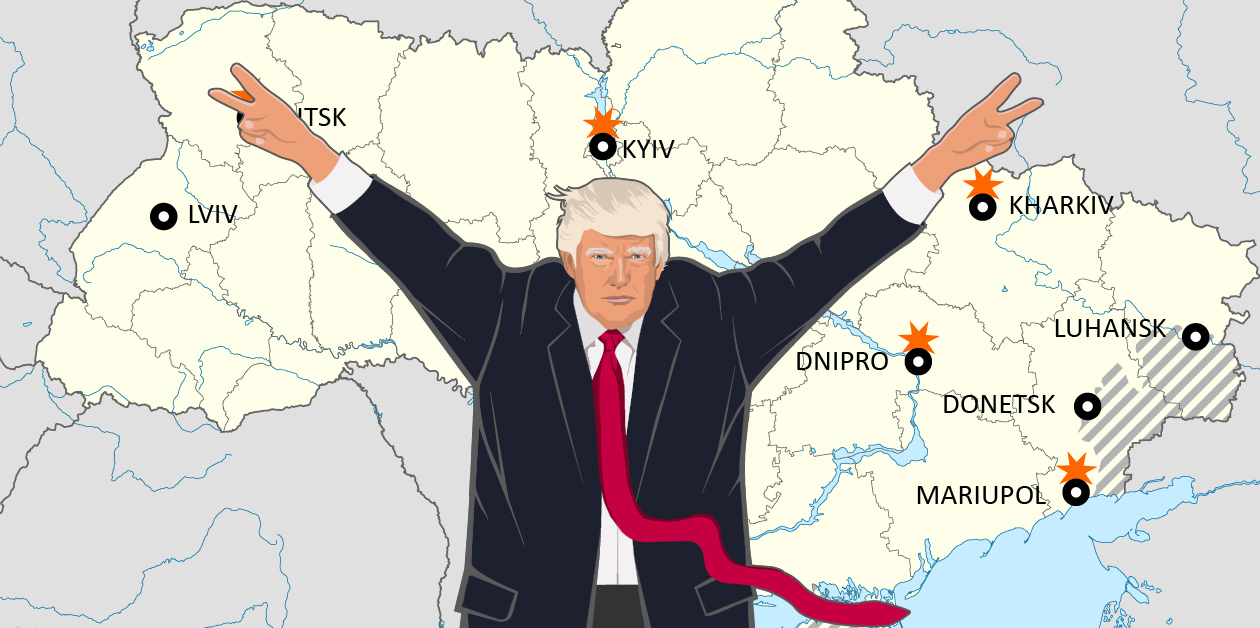
4. On the protection of core rights and liberties, the document asserts that, “When and where those powers are abused, abusers must be held accountable.” One might have thought that here or somewhere the document would address Russia’s illegal and unprovoked invasion of Ukraine, but no. Russia receives scant mention and remarkably none of it is critical. Under a section rather pompously entitled “Promoting European Greatness” we read:
“This lack of self-confidence is most evident in Europe’s relationship with Russia. European allies enjoy a significant hard power advantage over Russia by almost every measure, save nuclear weapons. As a result of Russia’s war in Ukraine, European relations with Russia are now deeply attenuated, and many Europeans regard Russia as an existential threat. Managing European relations with Russia will require significant U.S. diplomatic engagement, both to reestablish conditions of strategic stability across the Eurasian landmass, and to mitigate the risk of conflict between Russia and European states.
It is a core interest of the United States to negotiate an expeditious cessation of hostilities in Ukraine, in order to stabilize European economies, prevent unintended escalation or expansion of the war, and reestablish strategic stability with Russia, as well as to enable the post-hostilities reconstruction of Ukraine to enable its survival as a viable state.”
Europe is seen as in a dire state and “We want Europe to remain European, to regain its civilizational self-confidence, and to abandon its failed focus on regulatory suffocation.” For all the talk about the autonomy of the nation-state the document quite remarkably identifies as a priority for the US: “Cultivating resistance to Europe’s current trajectory within European nations”.
5. The document concludes with a short section on Africa.
I find this document helpful in that it clarifies and focuses what “America First” looks like in terms of foreign policy. But clarity, for me, certainly does not mean affirmation. One is not surprised to find the constant celebration of Trump – we have got used to this, irritating as it is – but far more chilling in my view is the direction set out for America’s relationship to the world. In geopolitics a discussion is ongoing about multipolarity and multilateralism. In a multipolar world, power is distributed among a few major powers each with its own sphere of influence. We see this clearly in this document with the US claiming the western hemisphere as its own hemisphere. There is no sense of the irony or contradiction in affirming the sovereignty of the nation-state while insisting that the western hemisphere be free of “foreign” interference, apart, that is, from America. One wonders what Canada or Columbia make of this?
Multilateralism is about cooperation between countries as genuine partners. Reading this document confirmed my view that as America moves away from international law and the rules-based structures set up after World War II we need to come up with multilateral models for a new alliance between (relatively) healthy countries that is built on respect and cooperation. In the process, as we know too well, there will be many areas on which to legitimately criticise the UK and Europe, some of which come up in this document. But the image presented of America in this document is not one, as millions of Americans realise, that many, if not most, non-Americans recognise or find attractive. And that is disturbing and worrying. But now we know, and we have the opportunity to think hard about it and, if you agree with me, craft alternative models for international relations.